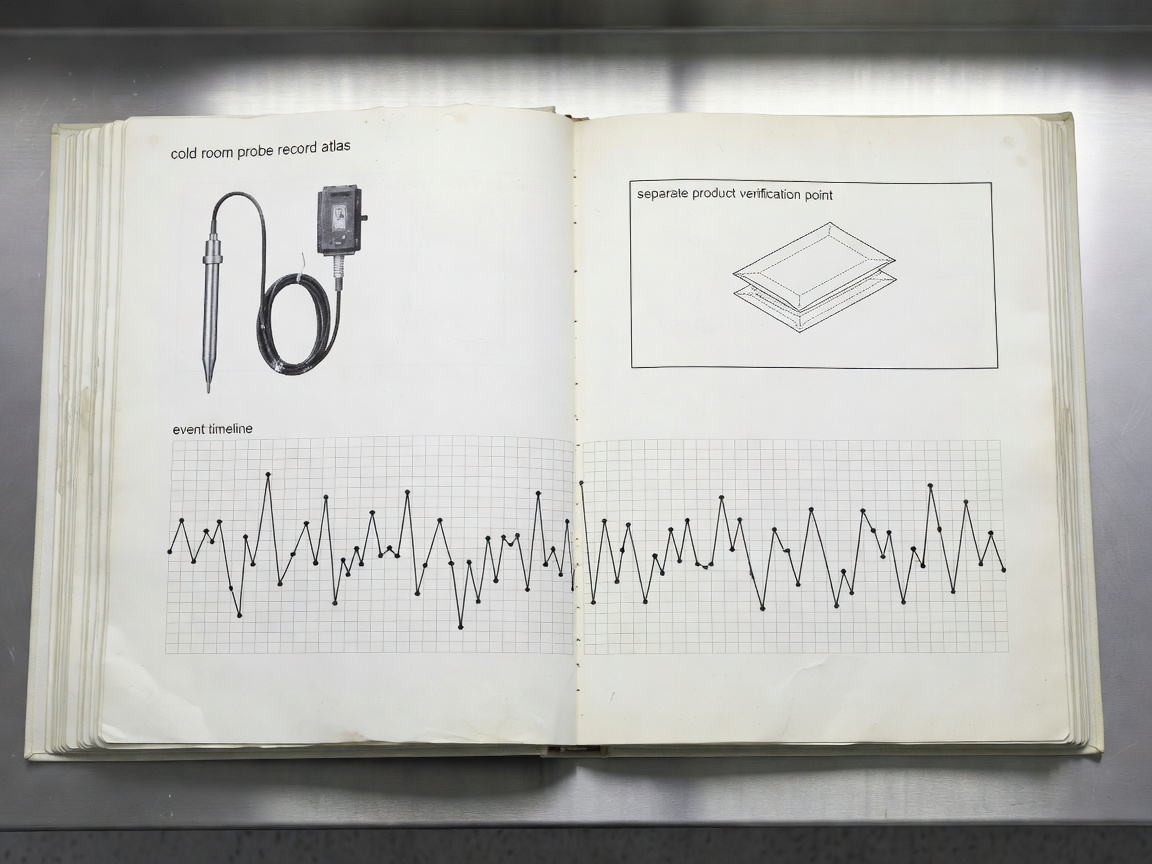
Define what the reading represents
A sensor beside an evaporator measures conditions at that position. It does not measure the centre of every carton, the warmest pallet in the room or the entire history of an arriving load. Air responds quickly to door openings and refrigeration cycles; a product’s internal temperature responds differently because of its mass, packaging and arrangement.
Start by stating the purpose of each instrument. Continuous room monitoring, transport logging and a receiving product check are different activities. A non-contact surface reading can help screen a load, but it should not be treated as a universal substitute for a validated product measurement. Intrusive checks also need hygienic procedures and appropriate equipment to avoid creating contamination while investigating temperature.
Place and maintain the evidence
Temperature mapping helps identify spatial variation under representative operating conditions. Consider doorways, high and low rack positions, airflow restrictions and defrost cycles. A room mapped while empty may behave differently when densely loaded. Changes to racking, airflow, refrigeration or operating patterns can justify reviewing the mapping rather than assuming the old sensor positions remain representative.
Choose devices suitable for the environment, including humidity, condensation and cleaning exposure. Calibration should be traceable and appropriate to the measurement range and required uncertainty. ISO/IEC 17025 provides a framework for the competence of testing and calibration laboratories. It does not, by itself, specify a warehouse’s monitoring interval or acceptable food temperature.
Every reading needs a useful timestamp, sensor identity and location context. Synchronise clocks and document timezone handling. If a device is moved, preserve the relationship between its old position and new position; otherwise a graph can look continuous while silently describing two different environments.
Turn alarms into owned actions
There is no single acceptable temperature for all food in every warehouse. Product specifications, applicable law, validated food safety controls and customer requirements determine the relevant limits. Set operating targets and alert rules with qualified food safety personnel. Avoid copying a generic number from a dashboard template.
An alarm should identify who must respond, how quickly escalation occurs and what evidence must be collected. Alert delays can help distinguish brief operational disturbances from sustained deviations, but they must be justified. Acknowledging an alert records that someone noticed it; it does not establish that the product is acceptable or that the cause has been corrected.
| Event | Immediate question | Record before closure |
|---|---|---|
| Door-open warning | Is access controlled and airflow recovering? | Door condition, duration and trend |
| Persistent temperature alert | Which locations and lots may be affected? | Investigation, checks and quality decision |
| Missing sensor data | Was monitoring interrupted or only transmission? | Gap interval and independent evidence |
| Calibration concern | Could past readings be unreliable? | Instrument assessment and impact review |
Handle a gap without inventing certainty
A communications outage and a sensor failure are not necessarily the same event. Some devices retain readings locally and transmit them later. Others leave an actual measurement gap. Recovered data should retain its original measurement times, while the system records when it was received. A smooth line interpolated across missing values is not a replacement for observations.
When conditions may have been outside the validated limits, identify the potentially affected lots and prevent inappropriate release. Quality personnel should evaluate duration, exposure, product characteristics, measurement uncertainty and the available evidence. A single favourable reading after the event cannot reconstruct the whole interval. Equally, an air-temperature alarm does not automatically mean every product must be discarded.
Carry the decision into the next move
The warehouse management system needs the operational result of the investigation. If stock is on hold, routing must not allocate it just because the cold room has recovered. Release authority and the reason for release should be visible to the people and systems making the next movement decision.
Codex Alimentarius CXC 1-1969 describes general food hygiene principles and HACCP. Regulation (EC) No 852/2004 establishes relevant hygiene obligations in the European Union. EN 12830 addresses temperature recorders for transport, storage and distribution of temperature-sensitive goods. Apply such references in context, with competent advice, rather than treating a device label as proof of an entire compliant process.
The practical goal is a defensible chain of evidence: what was measured, where and when it was measured, who reviewed the exception, and why the stock was released or withheld. That record is what makes the next handoff meaningful.
Reference points
Codex Alimentarius: codes of practice
ISO/IEC 17025: laboratory competence
Food Safety Authority of Ireland