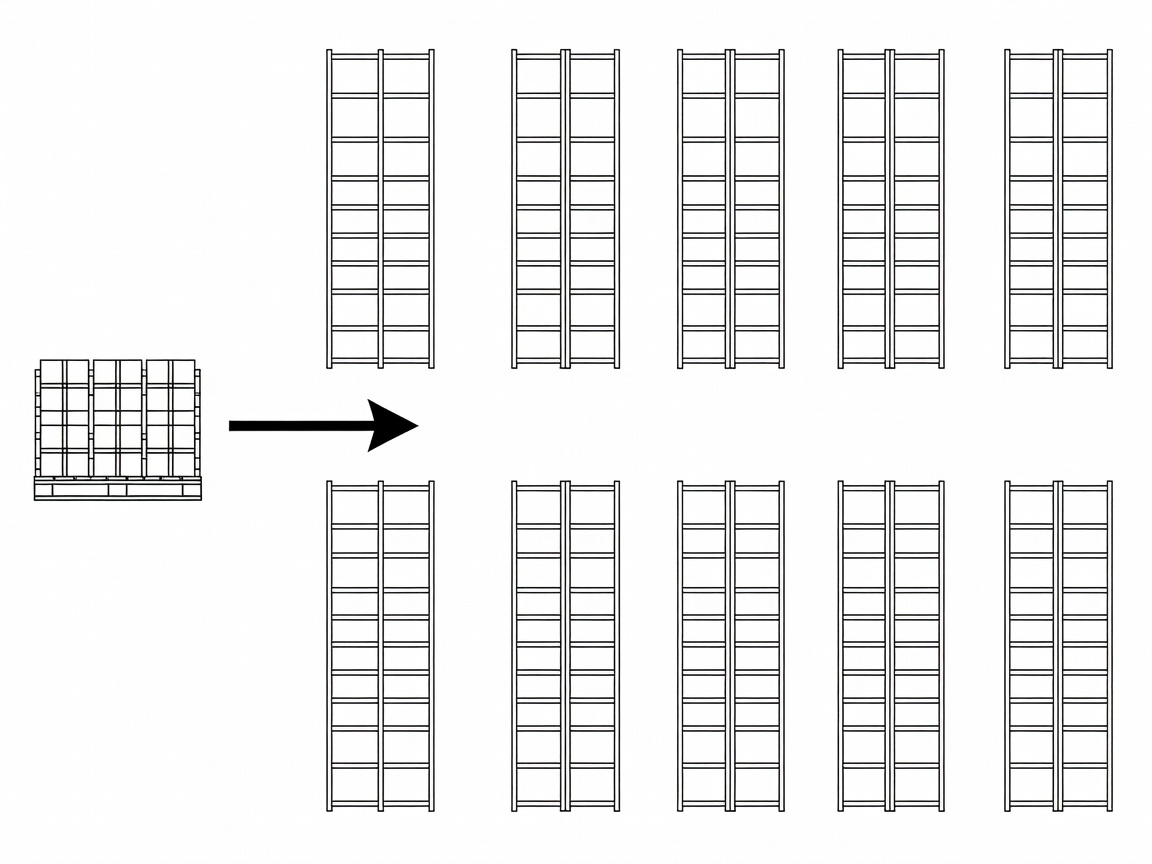
Establish what arrived
Picture a chilled-food pallet arriving at an inbound conveyor. Its label is readable, but that alone does not make it ready for storage. The receiving process must connect the physical load to an expected delivery, item identity, quantity, lot, date information and the relevant handling conditions. Damaged packaging or an unresolved temperature concern may require a quality hold before any putaway task is released.
A GS1 Serial Shipping Container Code, or SSCC, identifies a logistics unit. It does not independently prove the unit’s contents or condition. The warehouse still needs an accurate association between that identifier and the stock record. A duplicate label, a rebuilt pallet or an incorrect advance shipping notice can break that association. Resolving the mismatch at receipt is usually easier than discovering it deep inside an automated rack.
Match the load to the location
An automated storage and retrieval system, commonly called AS/RS, can use cranes, shuttles or other mechanisms to place and retrieve stock. The appropriate design depends on load format, throughput, access requirements, building constraints and the operating environment. A high-density arrangement can save space while making individual loads less directly accessible. Selectivity and density are a trade-off, not interchangeable benefits.
Location eligibility should include dimensions, weight, pallet condition, temperature zone and any required segregation. Allergen controls, packaging risks and site hygiene rules can also influence placement. Equipment clearance checks can reject an overhanging carton even when the inventory record looks correct. The rejection is useful information: forcing a marginal load into the system can turn a simple receiving issue into a difficult mechanical recovery.
Slotting then chooses among eligible locations. Fast-moving stock may benefit from shorter travel, but concentrating every popular item in one aisle can create congestion. Good slotting considers retrieval patterns, replenishment demand and resilience when a machine or aisle becomes unavailable.
Separate the decision from the motion
A warehouse management system, or WMS, typically manages inventory and storage tasks. A warehouse control system, or WCS, coordinates equipment movements. A warehouse execution system, or WES, may orchestrate work across several resources. Product names and boundaries vary, so a project should document responsibilities rather than assume the acronym defines them.
The critical interface is the task state. Requested, accepted, moving, completed and failed are different conditions. If a conveyor stops after the load leaves receipt but before the final location scan, the software must not simply pretend the move finished. The recovery process needs a known intermediate position and a safe method to reconcile the task.
- Validate load
- Reserve location
- Execute movement
- Confirm position
Design the exception route first
Automated racks are not a reason to eliminate physical verification. They make verification more important because access can be restricted. Cycle counting, identifier checks and inventory reconciliation should be designed around safe access and a clear record of adjustments. A discrepancy needs an owner, a reason code and an audit trail, not an unexplained quantity correction.
Plan for unreadable labels, broken pallets, unexpected weights, blocked locations, power interruptions and communication failures. Define who can release a stopped load, who can alter inventory and who can authorise maintenance access. Safe isolation and trained recovery procedures must come before attempts to improve availability.
Measure a useful outcome
Storage performance is more than moves per hour. Look at confirmed inventory accuracy, rejected-load causes, retrieval completion time, queue duration and the effort required to recover faults. Compare like-for-like operating conditions; a quiet shift and a dispatch peak tell different stories.
Before specifying equipment, test representative pallets and realistic demand profiles, including damaged packaging and difficult labels. Ask how food safety controls connect to inventory status. Regulation (EC) No 852/2004 and HACCP-based procedures provide important food hygiene context, while GS1 standards support consistent identification. Neither replaces a site-specific design review.
The next handoff begins when a stored pallet becomes a candidate for retrieval. Its location may be correct, but its condition must still be acceptable. That is where the environmental record becomes part of the movement decision.
Reference points
GS1: SSCC identification
Regulation (EC) No 852/2004: food hygiene
UK HSE: warehousing guidance